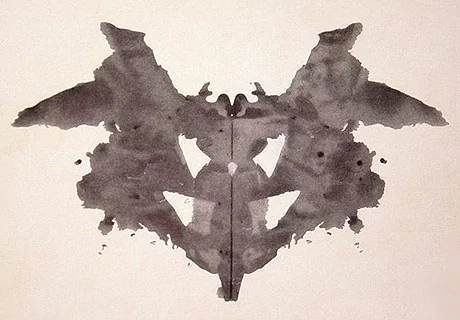
The Rorschach test, or Rorschach inkblot method, is a well-known projective personality measure. It uses symmetrical inkblots to study how people interpret ambiguous shapes. Nearly everyone has seen a blot that might suggest something familiar.
What you notice in each blot reflects personal tendencies and style of perception — that is what this kind of task is meant to explore. It is often called an inkblot test. You are asked what each image could resemble or suggest. What someone sees depends less on the blot itself (the shapes are deliberately vague) than on personality, mood, and context.
Today, many simplified “inkblot” quizzes circulate online. They are not equivalent to a full clinical Rorschach administration, which Hermann Rorschach introduced in 1921 and which became especially common in clinical practice in the 1960s. On this page you can complete a short, 10-item inkblot-style exercise without registration—just choose from the answer options for each image.
The history of the Rorschach test
The Rorschach is among the best-known projective techniques. It uses inkblots to elicit associations under relatively unstructured conditions. Scoring and interpretation in real settings rely on detailed coding systems (for example, the Exner Comprehensive System). In other words, clinicians analyze what people produce in response to the cards; those responses are thought to reflect aspects of personality and cognitive style (projection).
Take the Inkblot Test Online
Clinically, the method has been used to explore emotional functioning and personality structure, including situations where patients struggle to put thoughts and feelings into words. This online version is for education and entertainment only; it cannot replace a trained examiner or a standardized administration.
Look carefully at each image and choose the best-matching option from the list. Pick the description that most closely fits what you see in the inkblot. This exercise is for educational and entertainment purposes only; it cannot replace professional or medical services.
Question 1 of 10
What do you see here? What could it be?
Next picture
FAQ
Is it possible to prepare for the test and give the "correct" answers?
There are no right or wrong answers on a real Rorschach administration, and trying too hard to match a “normal” profile can itself be clinically meaningful. For this online exercise, answer honestly and don’t overthink what your choice “means”—there are no good or bad outcomes here.
How accurate is the online Rorschach test?
Like any online activity, this version has clear limits. Our scoring draws on simplified ideas from systems such as the Exner Comprehensive System (for example, how common a response type is and its general semantic direction). In a live evaluation, a trained clinician also notes card orientation, response timing, tone of voice, and other behavior—so an online quiz cannot match clinical interpretation.
Can the Rorschach test be taken multiple times?
Retaking it right away is not ideal. Once you remember the blots, the “recognition effect” makes responses less spontaneous. If you want to try again, wait at least a few weeks.
At what age can this test be taken?
In professional settings the method is typically used with adolescents from about age 16 and with adults, when a stable-enough personality structure makes results easier to contextualize.